
Layatown Lab · coming soon
You vs Laya. The AI in your own shoes.
You are one villager: your hero. The other 79 are decided by Laya, a System One model on one gaming GPU in Caracas. When something happens to you, you choose from the same options every villager has. Each night the same day is replayed, with the same luck and Laya deciding for you. Every day you beat the AI in your own shoes, or it beats you.
“You fought and saved Hester. AI-you fled; Hester died.”The nightly reveal, as the game says it
What decides: our fine-tune of Laya, an open model by Convai Innovations (Apache-2.0), trained on the decisions TypeSafe's Jev made while it ran this city (the study, the model card). No fee per decision; the owner pays the electricity. No launch date yet.
What it looks like so far
Four screens from the clickable prototype, captured in headless Chromium at 390 × 844. Laya's picks on day 1 are real model judgments; outcomes, experience, finds, the score and the counters are scripted or placeholders, and the prototype marks them on screen (the striped bar at the top, and "scripted" or "mock" tags).
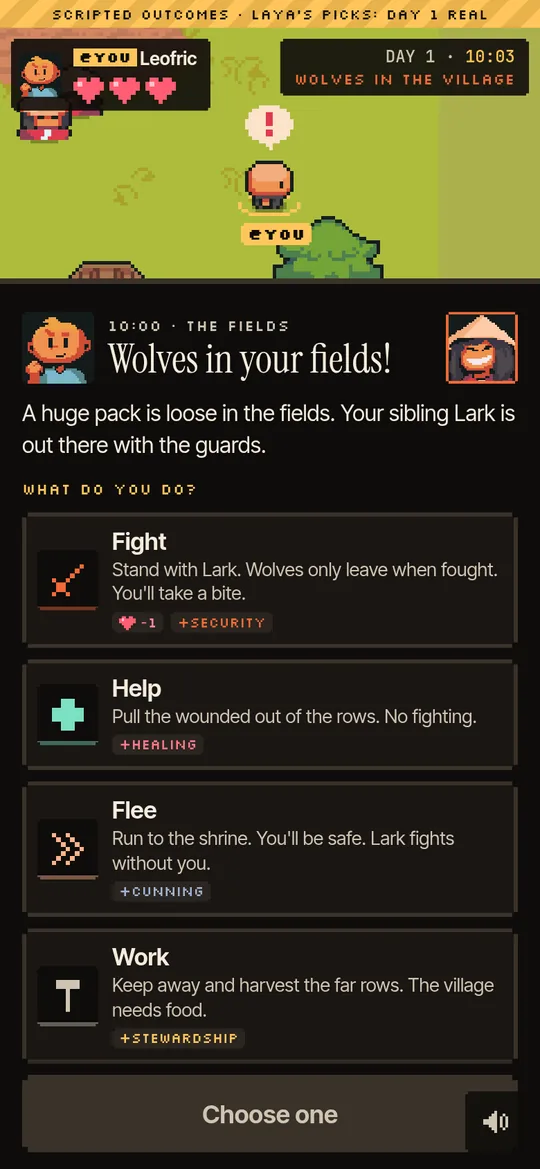
A moment. Wolves in your fields: you pick from the options every villager has.
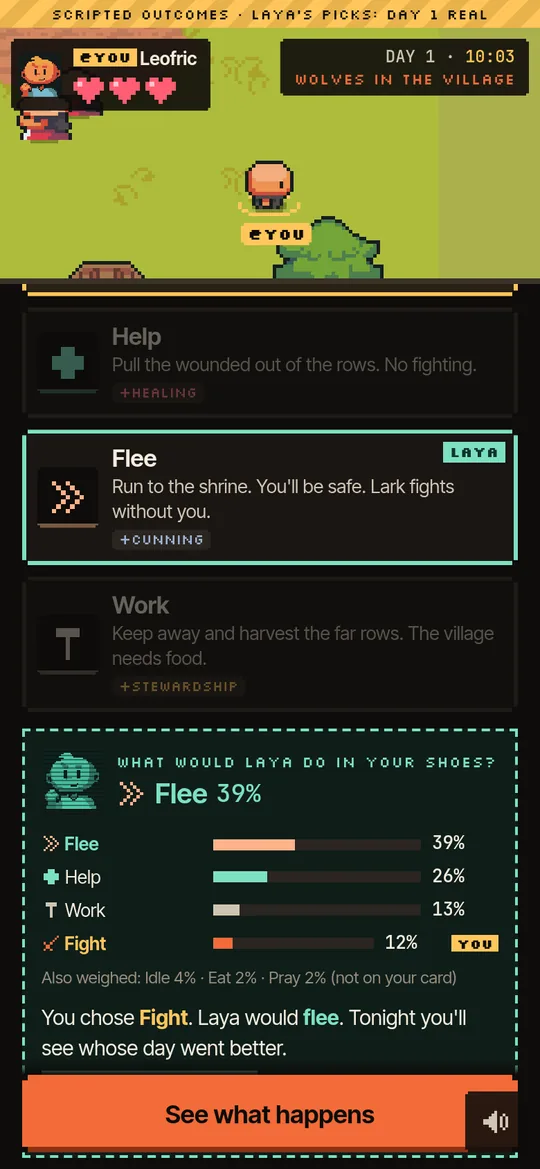
What Laya would do. Day 1's odds are a real judgment from
layatown-v1.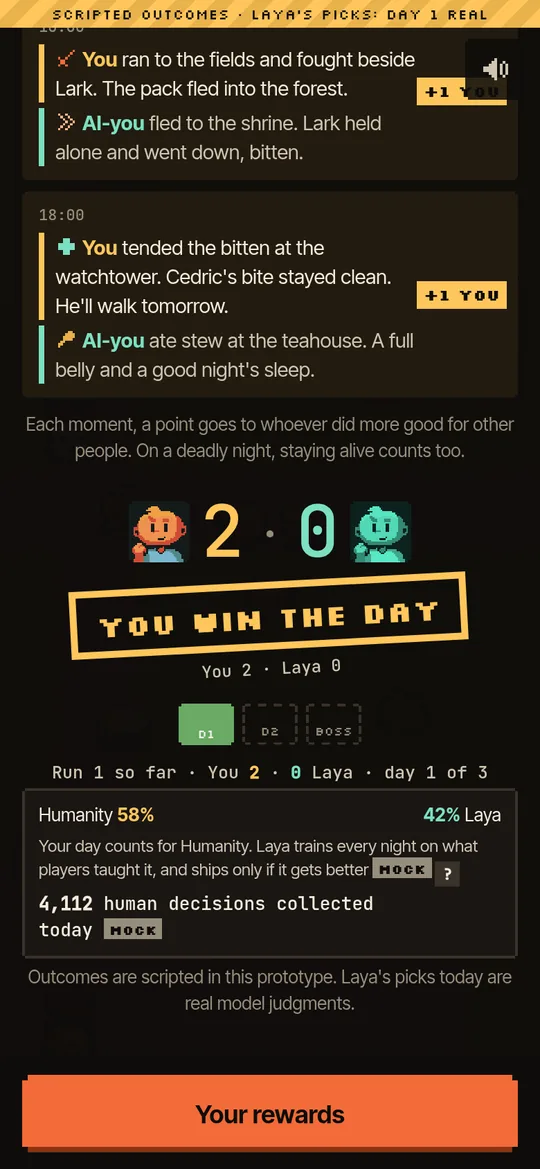
The nightly reveal. The same day, twice: your choices, then AI-you's.
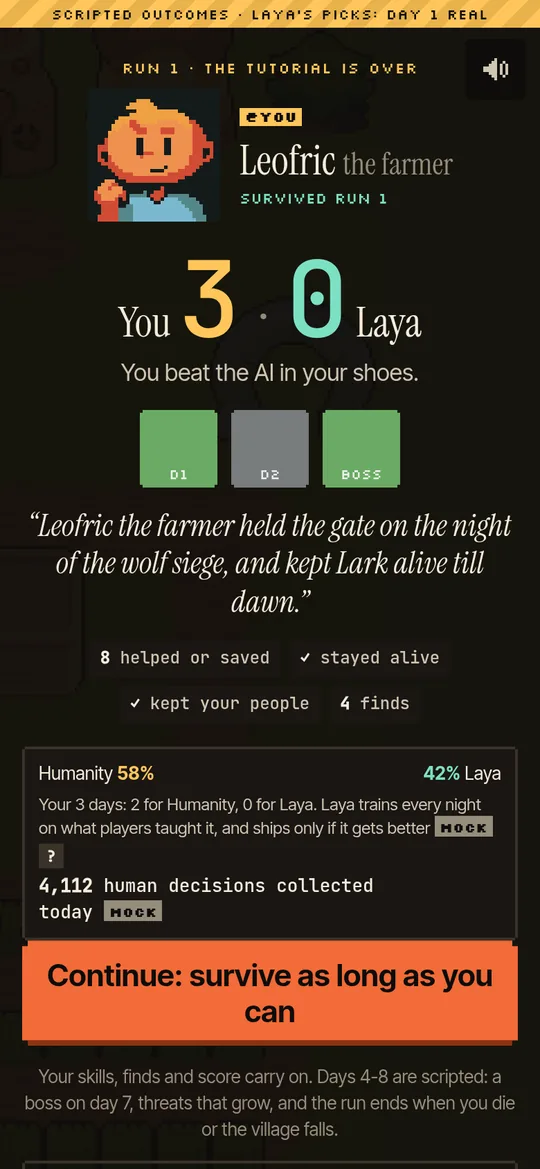
The end of a run. Your score against Laya, and a spoiler-free grid to share.
How a run works
- Your heroYou play one villager, from your X handle: a job, two traits, the people you love. Everyone else in the village is decided by Laya.
- MomentsWhen something happens to you (wolves in the fields, a sick child, an open purse) you choose from the same options any villager has. Code owns everything else: food, wounds, time, the dice.
- The nightly revealEach night the same day is replayed with the same luck, and Laya decides in your place.
You see both days side by side:
You fought and saved Hester. AI-you fled; Hester died.
- Runs until you fallRun 1 is a three-day tutorial that ends on a first boss. From run 2 a run lasts until your hero dies or the village falls: threats grow, a boss every four days, and your score against Laya builds up. Stop at any dawn; continue later.
- The share gridOne square per day: yours, Laya's or a draw. Spoiler-free, like Wordle's, so a friend can play the same seed, with the same luck, against the same Laya.
Skills, gear, rare finds from your own deeds, friends' heroes and a Mayor mode unlock as you play. Nothing is shown before it matters.
Why a System One model
Scripted characters are predictable. Characters run by a large language model are slow, cost money per turn, write text and make things up. A System One model gives a real judgment for every character at every moment, in milliseconds, with no fee per decision, and it is readable (a probability per option), explainable (ask again with one thing changed), and replayable: the same day, with the AI in your shoes. That last part is the game.
Humanity vs Laya
Every day a player finishes is a clean comparison: a person's choice and the model's choice in exactly the same situation, with the same luck, and what happened after each. Added up, it becomes a live global score: the share of days people did better than the AI in their shoes.
Illustration only: there is no score yet, because there are no players yet.
That dataset, humans against a judgment model in identical situations with the outcomes of both, barely exists today. It is the research at the centre of this project, and it goes in the study as it grows.
Laya trains every night on what players taught it, and ships only if it gets better
The plan, with the safety rules written first:
- Consent, off by default. A player's decisions join the training data only if they switch it on. What is shared: the situation, the options, the choice and what happened. Never a handle or a name. You can play without consenting and withdraw at any time.
- Weighted by outcomes. Decisions that worked teach more than decisions that did not, so a crowd playing badly on purpose cannot drag the model down with it.
- Frozen, tested versions. A candidate trains at night, when the GPU is freest, and is tested on the same pre-registered suites as today's model plus how it scores against players' logged days. It ships only if it passes. Every version is dated in a public changelog, regressions first.
- Never retrained mid-session. One training run takes 45 to 80 GPU-minutes on the same GPU that serves the game; learning online from anonymous players can drift or be poisoned; a version that changes all the time cannot be tested; and an opponent that changed mid-run would make scores meaningless. Within a session only your own Advisor learns from you.
None of this exists yet. Our first attempt at a model improving itself without its teacher was a trade-off and was not deployed: round 1 in the study. Capacity is not measured either: a player-day runs the day twice, estimated at 8 to 16 GPU-seconds, so the numbers get measured before anything is promised.
What is real in the prototype
- Real
- Laya's odds on day 1: judgments by
layatown-v1, exported from a village run, with the perception the model read. - Scripted
- Outcomes, experience, finds, coins, the village meter, and Laya's picks on days 2 and later.
- Placeholder
- The Humanity vs Laya score and the "decisions collected" counter. Nothing is sent anywhere.
- Art
- Ninja Adventure by Pixel-Boy and AAA (CC0).