Jev, explained like you're five
What it is, what to build with it, what it costs, how it makes big models better, where it quietly fails, and what comes next. With receipts.
By elberacasa, 20 September 2026. Also published as an article on X. An independent write-up, not affiliated with TypeSafe. Figures marked as measured come from this project's logs and benchmarks (the study); the token and dollar totals in the opening are the author's whole TypeSafe account; section 7 is opinion and says so.
Everyone on my timeline is asking the same thing about Jev: "ok, but what do I actually use it for?"
I've put 662 million tokens through it in four days, running a live city of 1,000 simulated people where every decision is made by Jev. The whole bill was $22.61. This is what I wish someone had told me on day one.
1. The one idea: a writer and a referee
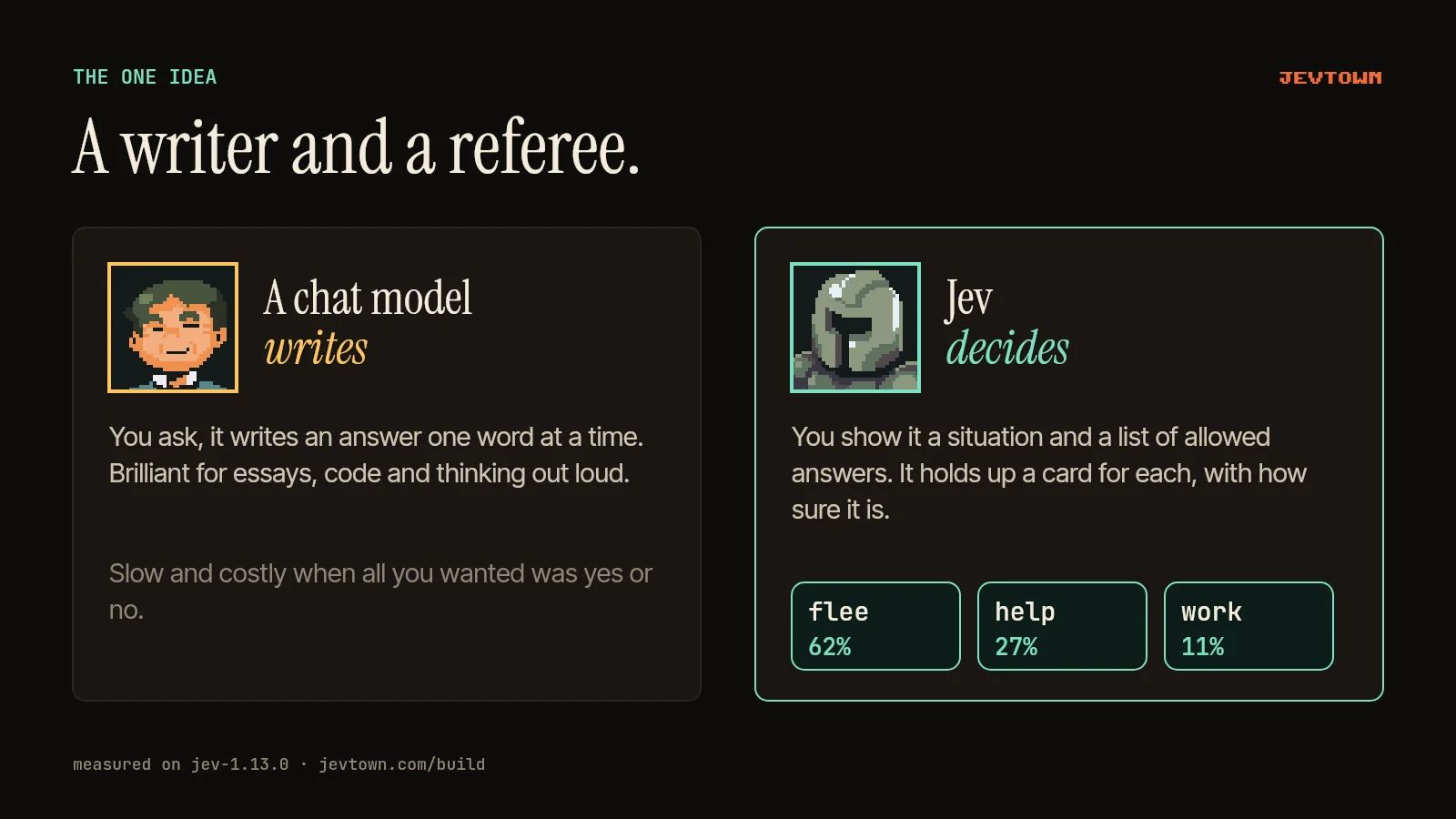
A chat model is a writer. You ask, and it writes an answer one word at a time. That is wonderful for essays, code and thinking through a problem.
Jev is a referee. It does not write anything. You show it a situation and a list of allowed answers, and it holds up a card for each one with how sure it is. Flee 62%, help 27%, keep working 11%.
That's the whole product. It sounds small. It isn't, because of what it costs.
2. How you talk to it
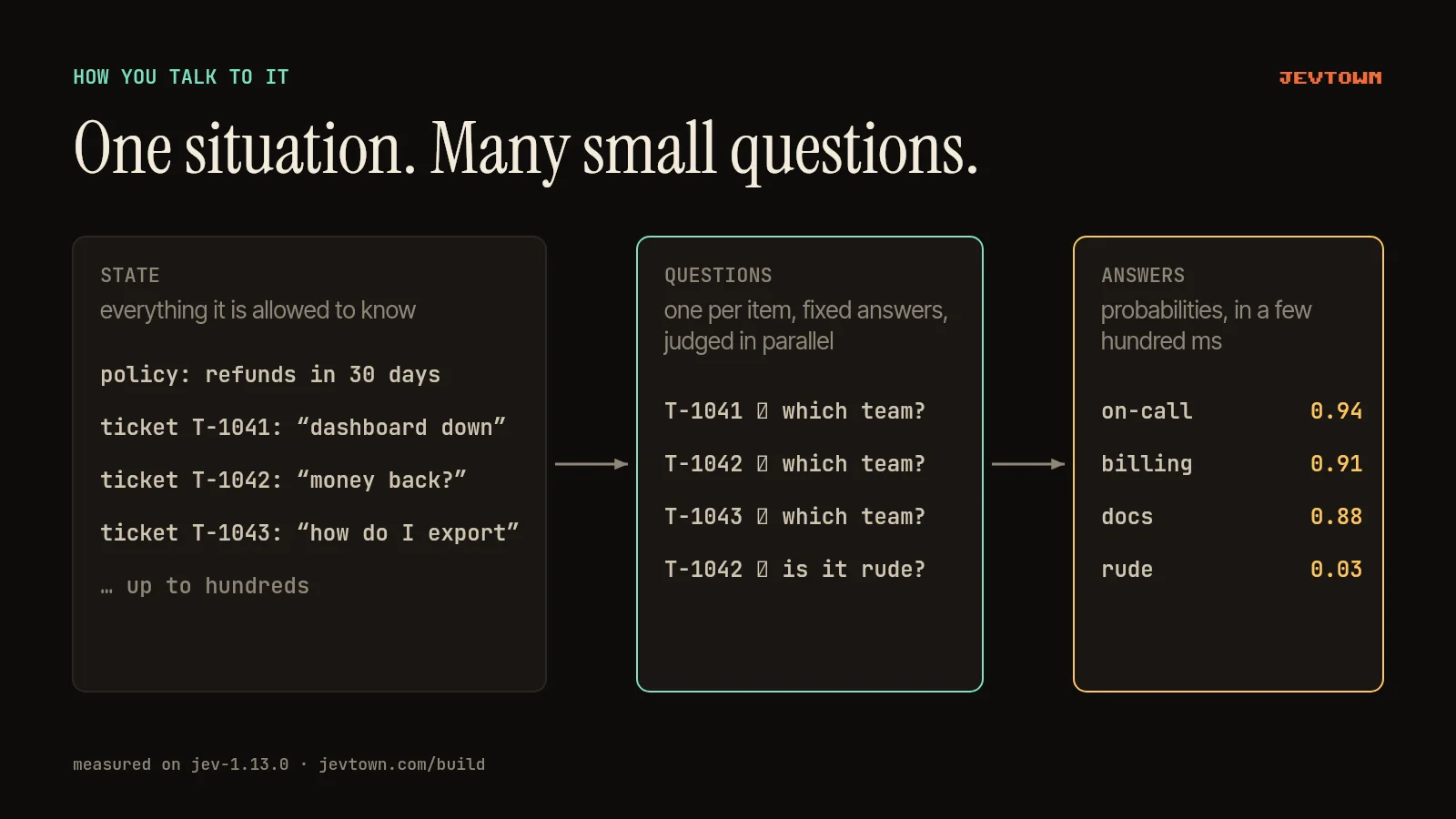
One request has two parts:
- State: everything it is allowed to know. A policy, a ticket, a person, a world.
- Questions: as many as you like, each with a fixed set of answers. Yes or no. One of these five routes. A level from 1 to 5.
Hundreds of questions can share one request. They are judged independently, at the same time, and come back as probabilities in a few hundred milliseconds. In my city, one request carries 100 people, ten requests run in parallel, and all 1,000 decisions come back in 0.98 seconds (measured, median).
3. Why anyone cares: what one dollar buys
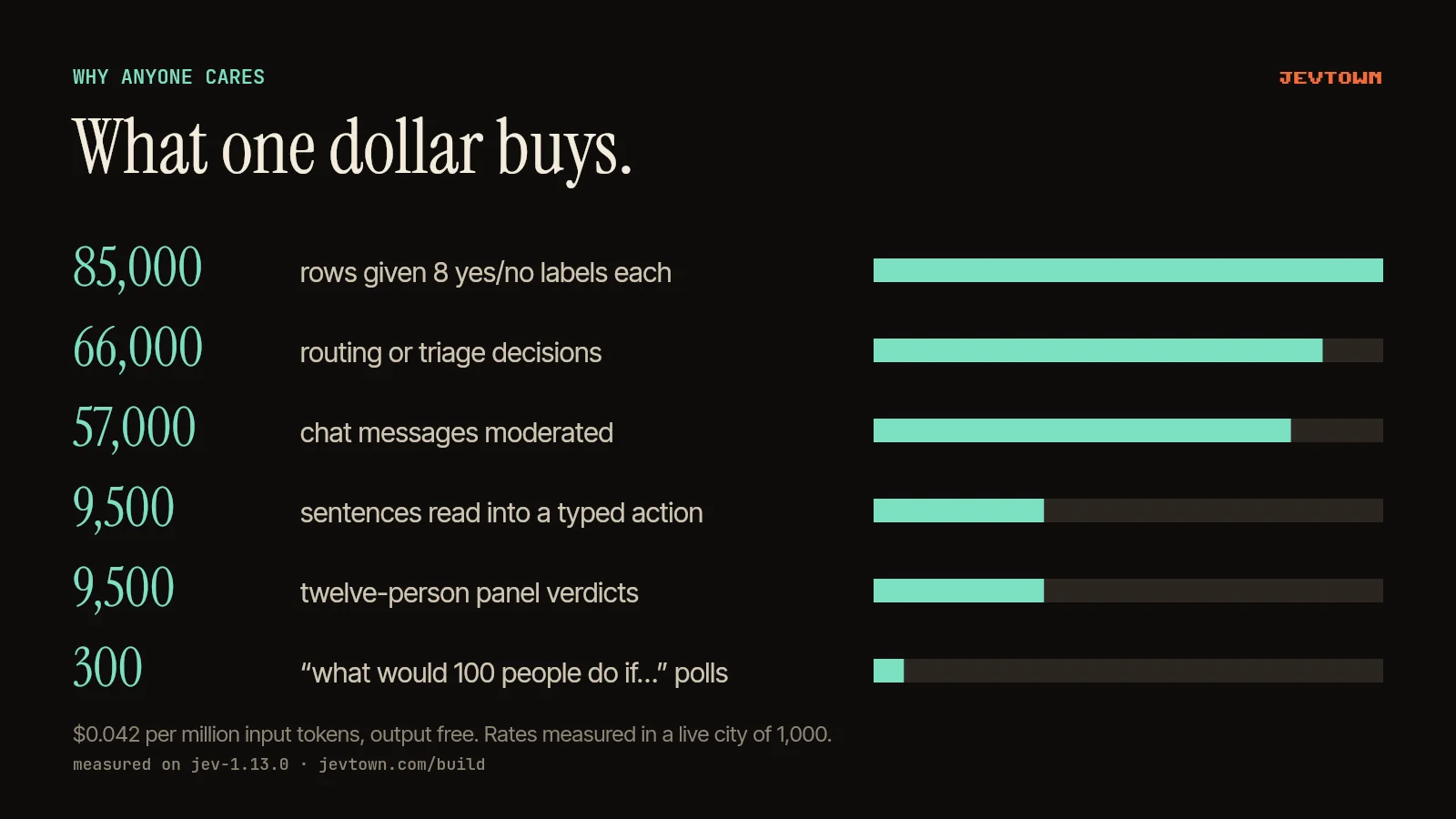
Input costs $0.042 per million tokens and output is free. At the rates I measured in production, one dollar buys roughly:
- 85,000 rows given eight yes/no labels each
- 66,000 routing or triage decisions
- 57,000 chat messages moderated
- 9,500 sentences read into a typed, structured action
- 9,500 verdicts from a twelve-member panel
- 300 polls of "what would these 100 people do if this happened?"
When a judgment is this cheap you stop sampling and start checking everything: every message, every row, every step.
4. Six things you could build this week
Does your idea fit? Four questions. Is the answer one of a fixed set? Do you have lots of them, or need one right now? Can each be judged from what is in front of it, in one step? Can you write the rule in a sentence? Four yeses means it's a Jev problem.
- Inbox triage. Every ticket routed against one written policy. About $1.50 per 100,000.
- A guard on your agent's tools. "Is this call inside the task it was given?" Asked before every single call.
- Moderation that reads meaning instead of matching words. About 2 cents per 1,000 messages. It lets "scunthorpe_fc" through and stops the real thing.
- A plain-language front door. A user's sentence becomes a typed, auditable request, or a refusal. Nothing is ever executed from text.
- A dataset labeller. Eight attributes on a million rows for about $12.
- A review panel. Security, performance and the maintainer each vote on a change; a split vote is your signal to call a human.
I priced thirty of these, with requests you can copy, at jevtown.com/build
5. It doesn't replace your big model. It makes it better.
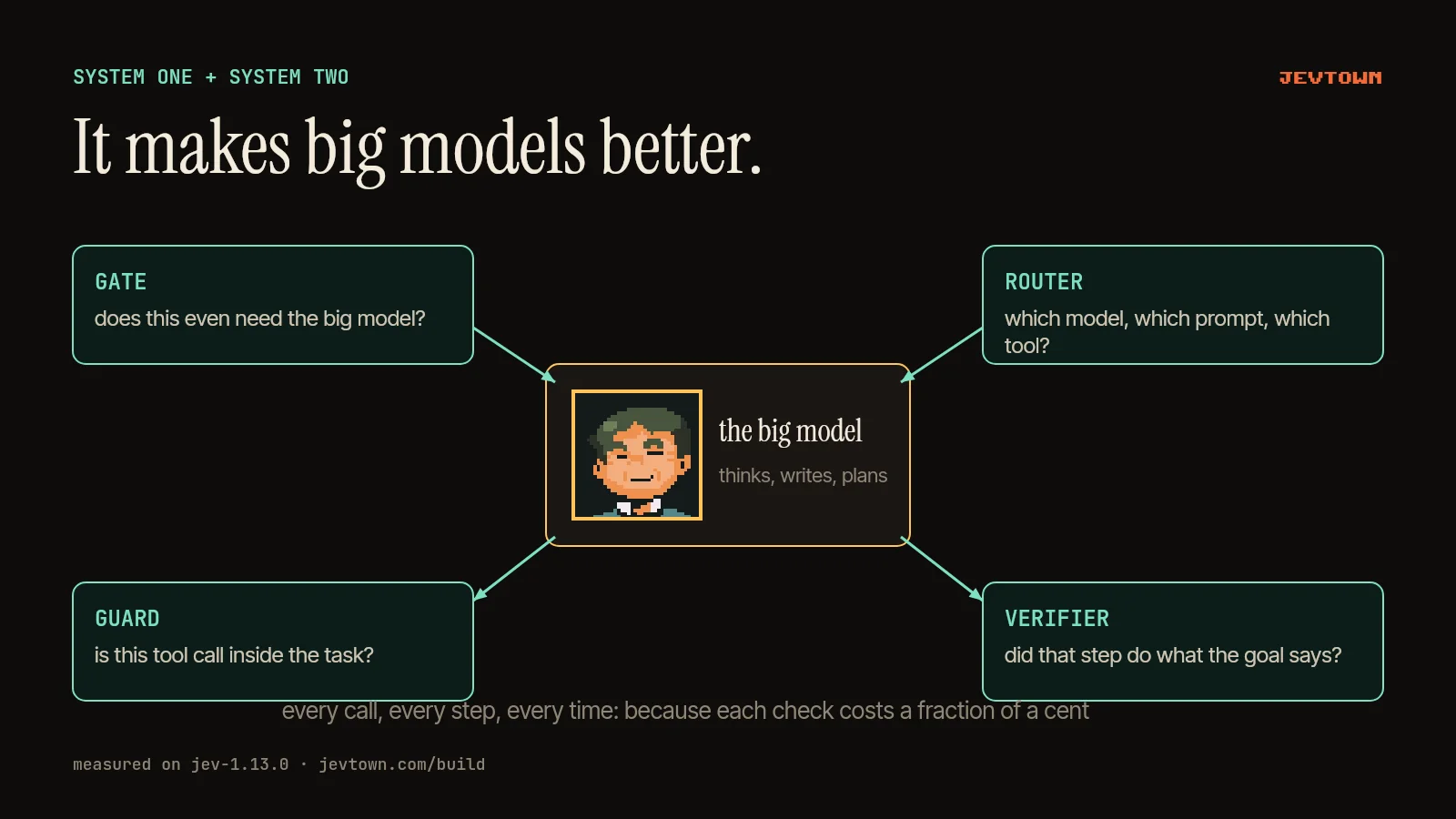
Think of the big model as the part that thinks slowly and well, and Jev as the reflexes around it:
- Gate: does this even need the big model? Most things don't.
- Router: which model, which prompt, which tool should take it?
- Guard: is this tool call inside the task? Checked every time, because it can be.
- Verifier: did that step do what the goal says? A cheap check between steps beats a long apology at the end.
The big model gets called less, gets better inputs, and gets checked more often. That is the amplification: not a smarter model, a better-run one.
6. Where it fails, quietly
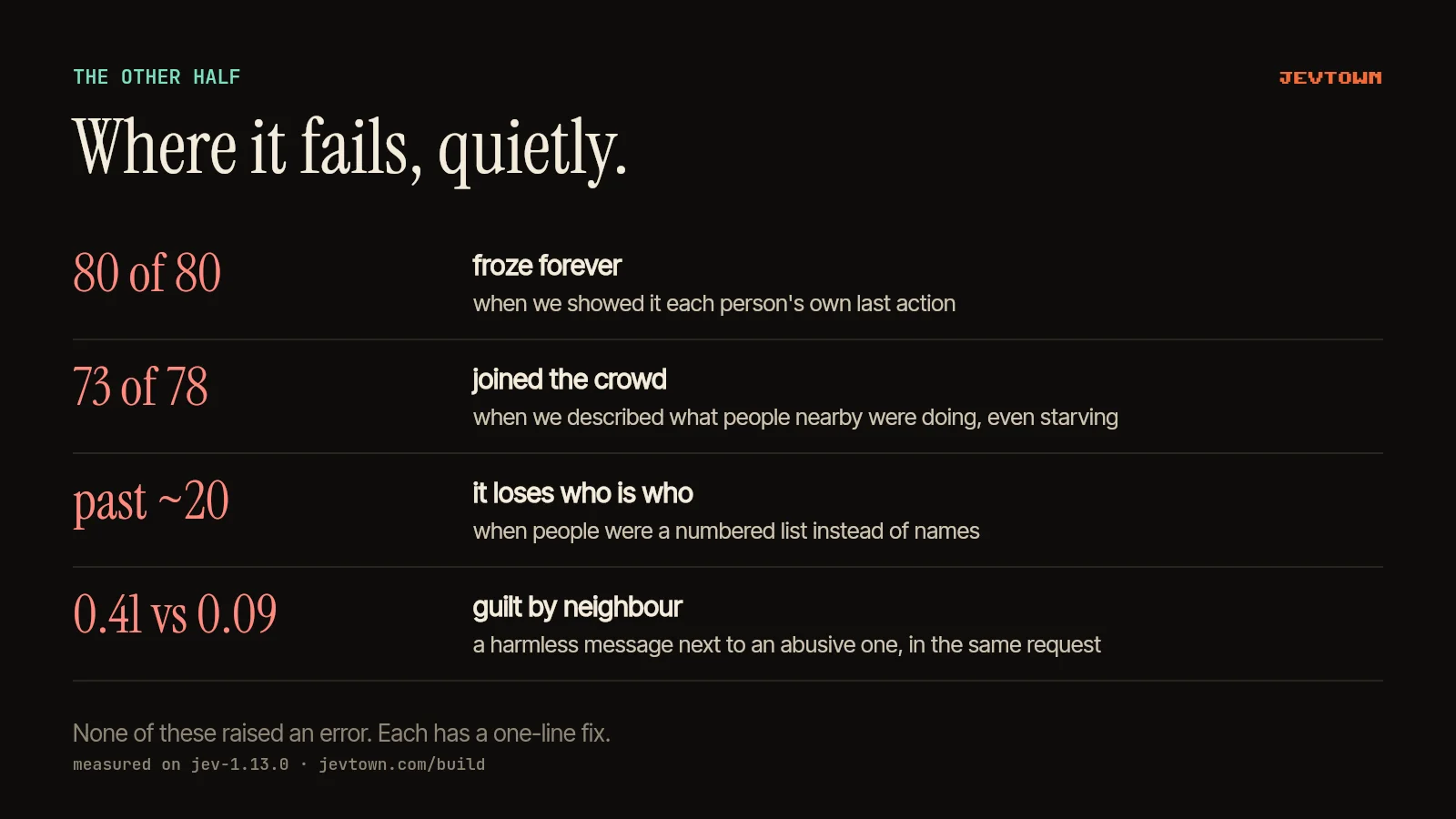
Half of what I learned is what breaks. None of these raised an error; all of them were invisible in a single answer and obvious across a population.
- I showed each villager their own last action. 80 of 80 repeated it forever. Never show it its own last answer.
- I described what the crowd nearby was doing. 73 of 78 joined in, even the starving ones. By day three the whole village was praying.
- I addressed people by their position in a list. Past about twenty items it lost track of who was who. Key everything by name. It cannot count, and a list index is a count.
- I moderated several chat messages in one request. A harmless line scored 0.41 for abuse because it sat next to an abusive one; alone, harmless lines average 0.09. One item per request when fairness matters.
And one that matters for anyone hoping it will predict things: asked directly which of two real posts did better, it was at chance. Used as a feature extractor under a small model fitted on real outcomes, it beat the baseline. It is an instrument, not an oracle.
7. What gets built next (my predictions, not measurements)
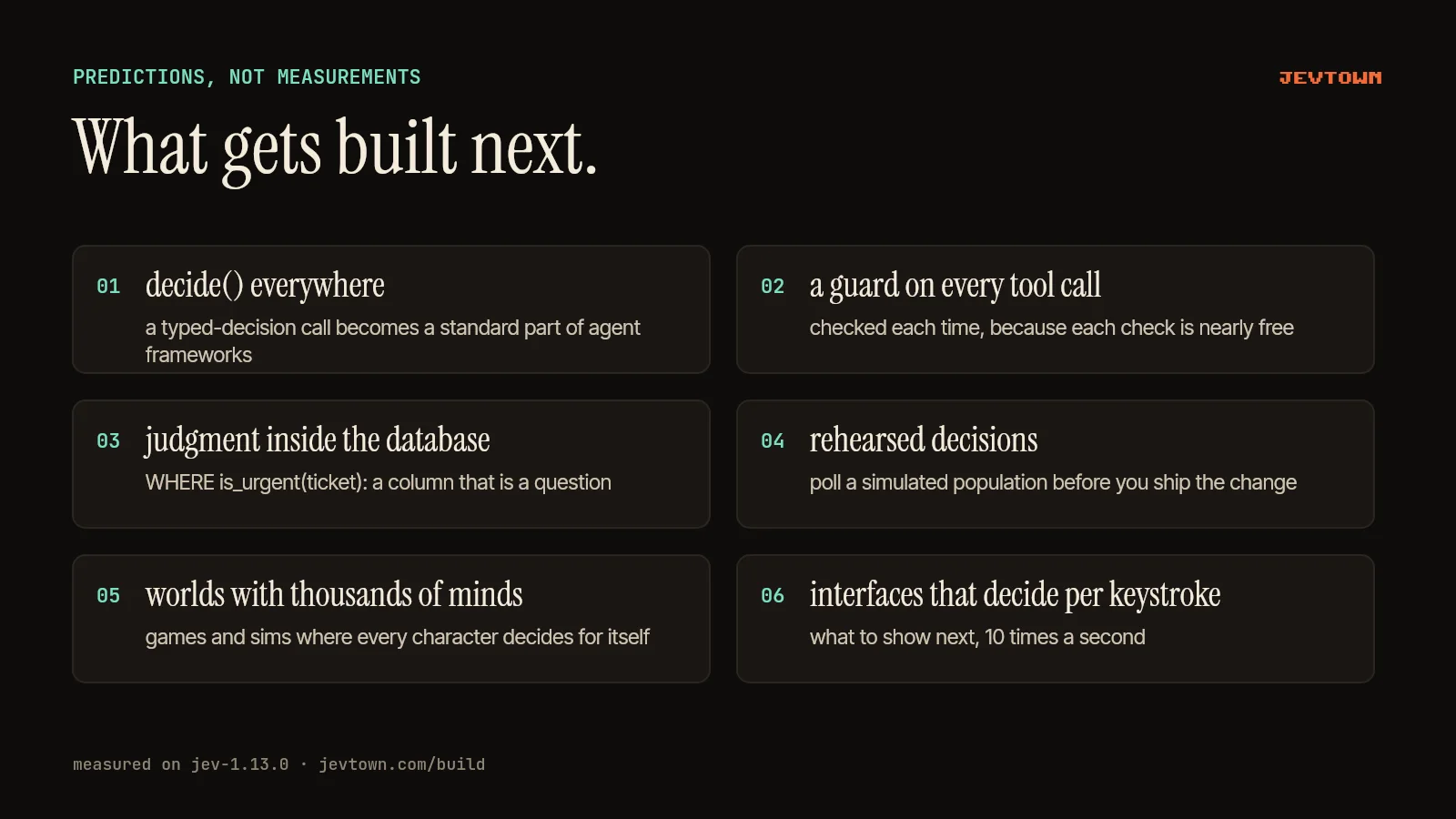
- decide() everywhere. A typed-decision call becomes a standard part of agent frameworks. It is already starting.
- A guard on every tool call. Today we audit agents after the fact. At these prices you check every action before it happens.
- Judgment inside the database. A column that is a question: WHERE is_urgent(ticket).
- Rehearsed decisions. Before you ship a price or a policy, poll a simulated population with and without the change. My city does this before every vote: 100 people, asked twice, in about 0.6 seconds for a third of a cent.
- Worlds with thousands of minds. Games and simulations where every character decides for itself, and the whole run replays from logs without the model.
- Interfaces that decide per keystroke. What to show next, ten times a second.
The pattern underneath all six: wherever a person, a regex or a large model is making the same small judgment over and over, a System One model takes that seat.
The proof it runs
The city is live at jevtown.com: 1,000 people, every decision by Jev, a public ledger of every dollar. The study behind every number here, failures included, is at jevtown.com/study. The field guide with the calculator and the requests to copy is at jevtown.com/build.
If you build one of these, tell me. I'll add it to the guide.